Introduction: Two Decades of Application Performance Monitoring Excellence
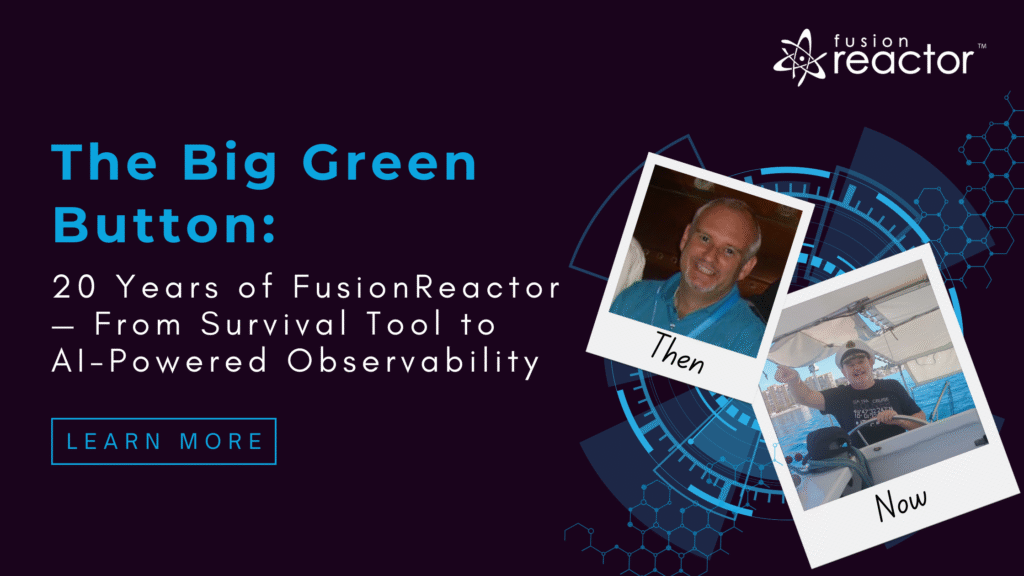
December 2025 marks a significant milestone in the history of application performance monitoring: FusionReactor celebrates its 20th anniversary. What began in 2005 as a ColdFusion troubleshooting tool has evolved into a comprehensive observability platform with AI-powered capabilities, serving organizations worldwide. This is the story of FusionReactor’s evolution—told through the voices of the team members who built it and the technical innovations that defined each era.

The Origins: From Necessity to Market Leadership
How FusionReactor Was Born
FusionReactor wasn’t originally planned as a standalone product. The application performance monitoring tool emerged from a practical need—troubleshooting Tornado, Intergral’s document management system. This pragmatic origin established core principles that would guide development for two decades: identify real problems, build effective solutions, and never compromise on quality.
Greg, a team member since August 1999, describes the pivotal transformation: “The biggest change in the company was going from working on multiple things like website projects, design work, and Tornado to creating FusionReactor—a mass appeal product that really focused the company into a certain area.”
The First Release: FusionReactor 2005
When FusionReactor first became available for download in 2005, it introduced capabilities that would become industry standards in application performance monitoring:
- Real-time visibility into application performance
- Deep code-level analysis for Java and ColdFusion applications
- Production-ready monitoring with minimal overhead
- Troubleshooting tools designed by developers, for developers
Bernd, who joined in 2002, identifies this moment as his most memorable: “When we made the very first version of FusionReactor available for download.”
The Philosophy: Never Give Up
Core Values That Shaped 20 Years of Development
When asked to describe FusionReactor’s journey in three words, long-standing team members consistently emphasize:
“Never Gave Up” John, with the company since 1999, explains: “We always started with what we wanted to have and never questioned whether we could do it. With persistence, dogged determination and grit, we could solve anything. Problems that seemed insurmountable were, after a while, solvable.”
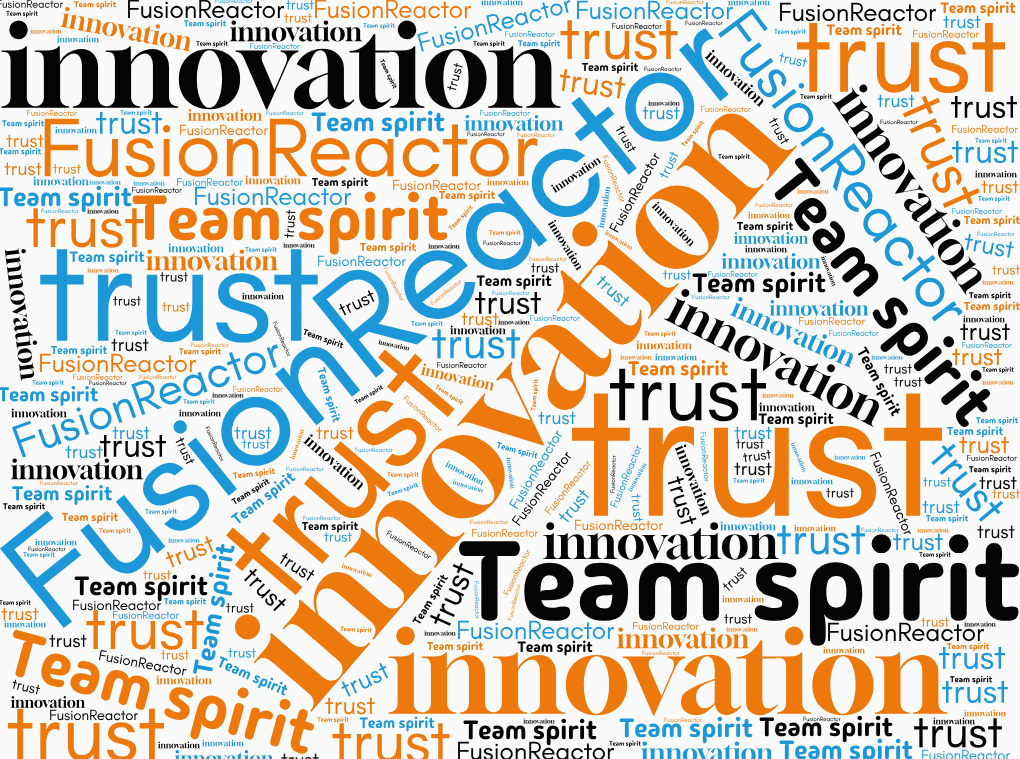
“Trust, Team Spirit, Innovation” (Bernd) “Learning, Refining, Growing” (Team member, 2014) “Ever-changing Evolving Growth” (Team member, 2015)
These principles aren’t marketing slogans—they represent the methodology that enabled FusionReactor to evolve continuously while maintaining product stability and user trust.
The Timeline: 20 Years of Application Performance Monitoring Innovation
2005: Foundation Year
FusionReactor 1.0 Launch
- Initial release establishing core APM capabilities
- Focus on ColdFusion and Java application monitoring
- Real-time performance visibility
- Production-ready deployment architecture
2006: Enterprise Scale
FusionReactor 2.0
Key innovations in application performance monitoring:
- Enterprise Dashboard: Centralized real-time health monitoring across multiple production environments
- Advanced Data Collection: Stack traces, SQL support via JDBC Wrapper, complete request/response capture
- Flex/Flash Remoting Support: AMF data monitoring capabilities
- Crash Protection: Automatic self-healing with configurable server survival strategies
- Automated Detection: Simplified installer with automatic server/instance discovery
2008-2011: Platform Expansion
FusionReactor 3 & 4
Application performance monitoring matured with:
- ColdFusion 6, 7, 8, and 9 support
- 64-bit architecture compatibility
- LiveCycle Data Services monitoring
- AIR client introduction
- AMF monitoring and debugging capabilities
- Enhanced log management systems
- Sophisticated memory graphing
- Critical Architecture Change: Transition to Java agent—foundation for all future development
2013: The Modern Era Begins
FusionReactor 5
A comprehensive reimagining of application performance monitoring:
User Experience Revolution:
- Responsive user interface design
- Non-Flash graphing components
- Mobile applications for Android and iOS
Monitoring Capabilities Expansion:
- Servlet support across J2EE platforms
- End-to-end user monitoring with real user performance metrics
- Auto-wrap JDBC data sources (eliminating manual JDBC wrapper configuration)
- Hibernate and MongoDB support
- Active session monitoring
- HTTP status code tracking
Enterprise Features:
- User-defined transactions
- Enhanced alerting and notification systems
- EnGuard Server Protection
- Elastic Cloud Monitoring licensing
- Extended J2EE platform support (JBoss, Tomcat, Jetty, GlassFish)
One team member highlights the lasting impact: “The licensing we built for FR8 onwards—a solution that’s still working six years later.”
2015-2018: Deep Code Visibility
FusionReactor 6 & 7
Developer-focused enhancements:
- FR6: Integrated debugger for production environments
- FR7: Code profiler for performance bottleneck identification
- Method-level execution analysis
- CPU time tracking per code path
2019-2023: Cloud-Native Transformation
FusionReactor 8-11
Application performance monitoring evolved for modern architectures:
FR8 (2019):
- FusionReactor Cloud platform launch
- Docker container support
- Enterprise Distributed Data Store (EDDS)
FR9 (2023):
- Automated log shipping to cloud
- Centralized log aggregation
FR10 (2023):
- Platform consolidation and optimization
FR11 (2023):
- DEEP integration (Dynamic Extensible Execution Platform)
- Cloud support for error history, longest transactions, slow queries
- Event snapshot capabilities
- Enhanced memory transaction analysis
2024: Breaking Infrastructure Barriers
FusionReactor 12
Architectural innovations:
- Observability Agent Integration: Full integration within FusionReactor Agent Monitoring (FRAM)
- WebSocket Tunnel Technology: Revolutionary remote access enabling on-premises UI access directly through FusionReactor Cloud—eliminating complex networking requirements and firewall configurations
2025: AI-Powered Observability
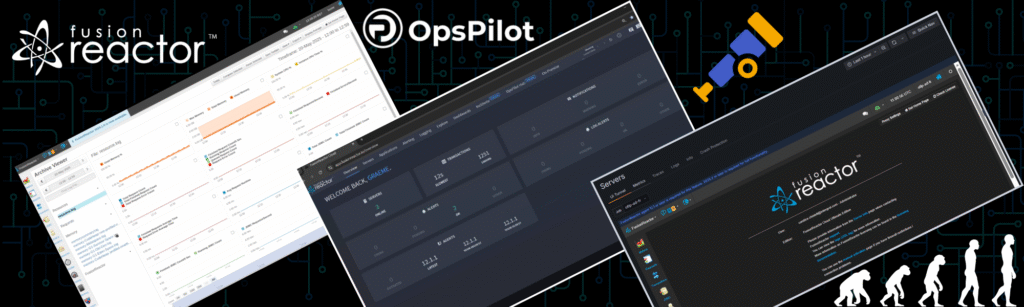
FusionReactor 2025
The latest evolution in application performance monitoring combines artificial intelligence with industry standards:
OpsPilot AI Platform:
- Natural language query interface for monitoring data
- Predictive analytics for proactive issue detection
- Intelligent root cause analysis
- Automated insight generation
OpenTelemetry Integration:
- Full OpenTelemetry (OTel) standard compliance
- Industry-standard telemetry data collection
- Vendor-neutral observability framework
- Future-proof architecture for evolving monitoring standards
Platform Enhancements:
- Modernized billing and administration
- Comprehensive documentation updates
- Enhanced user experience across all interfaces
The Technical Achievements: Engineering Excellence
Groundbreaking Innovations Nobody Else Had
John identifies several technical achievements that positioned FusionReactor ahead of competitors:
The Vortex Visibility Engine (Early Years) “Mike Capp produced a specification for a system which would take a tree of folders and documents, and a set of users and groups, and would work out what that user could ‘see’ and access. Our nearest competitors (OpenText and Microsoft SharePoint) had nothing like it.”
FusionDebug 1.0 “An enormously complicated product—one of the hardest things I’ve ever worked on, requiring knowledge in so many different areas.”
GCS Backend Component “Handles persistent communication back to individual FusionReactor Agents. It’s the part of the software that enables you to ask FusionReactor Cloud ‘What web requests are running right now?’—to ask a question in Cloud and get it immediately answered by the agent. Nobody had anything like it.”
OSGi Conversion “As the FusionReactor codebase grew, we refactored it into discrete modules managed by OSGi. Once it was done, it made everything easier: code, build, test, and proper separation of concerns.”
Modern Engineering: Speed, Stability, and Open Source
A team member who joined in 2015 highlights recent technical priorities: “Cleaning up our services, moving parts of the stack to open source and Go, and improving speed, stability, and resource usage across the board.”
This focus on foundational excellence—not just feature addition—exemplifies the engineering philosophy that has sustained FusionReactor for 20 years.
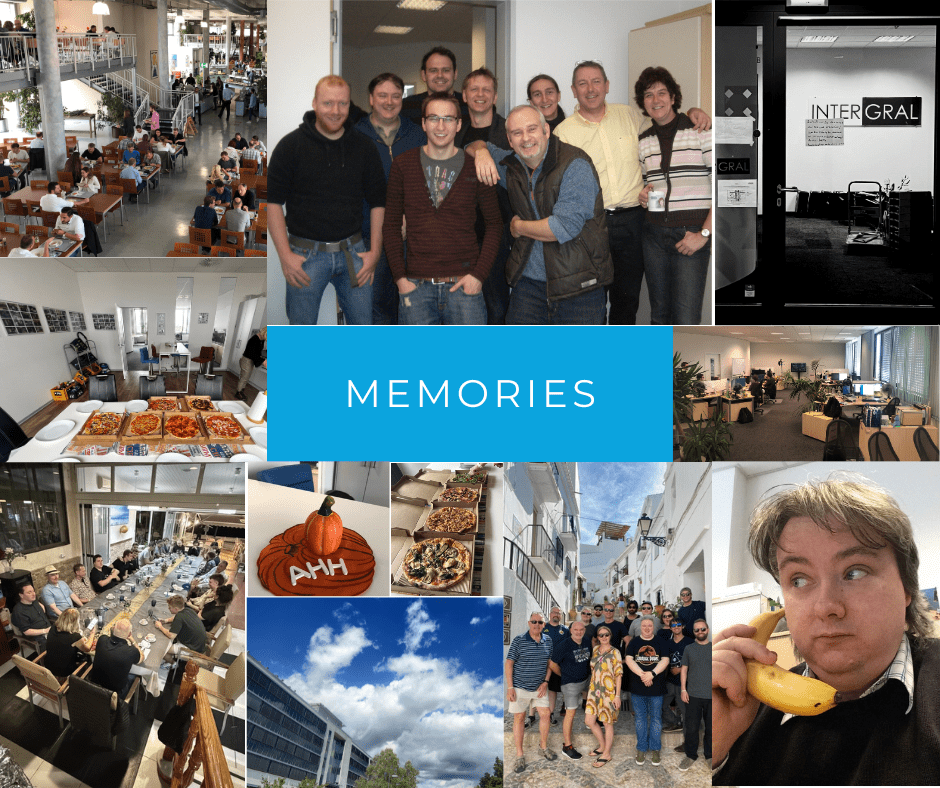
The Culture: Family, Innovation, and AI-Assisted Development
Building Software as a Team
Bernd captures what he’s most proud of: “What makes me most proud is that we have always managed to treat each other like family here at the company.”
This culture manifested in both work and play:
Work Memories:
- Whiteboard sessions, redesigning the licensing system—”hours in a meeting room sketching and revising models until we landed on a solution”
- Launching the first version of FusionReactor available for download
- The two-week intensive building of the Vortex Engine
Team Experiences:
- Half-life deathmatch sessions after work in the early days
- Lunches at the Thai restaurant with its huge aquarium
- Christmas parties with live bands at the Hasen in Herrenberg
- Summer picnics at the IBM Club
- Flying afternoons
- The team trip to Málaga, Spain in 2024
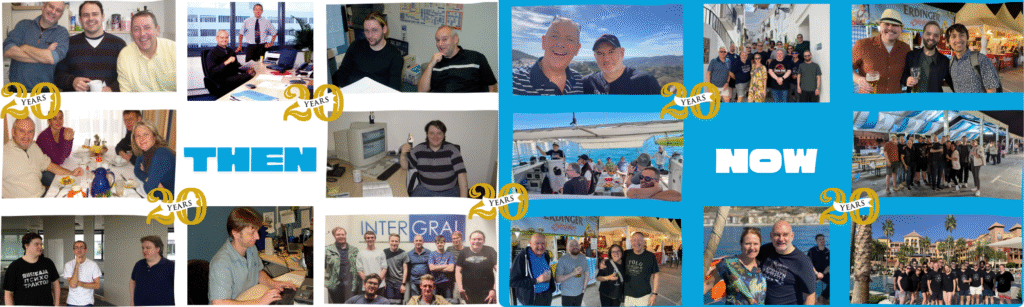
A team member reflects: “Before we went remote, a lot of us lived in the same town and had pretty much a constant social circle. The company might have only met officially once or twice a year, but we were always hanging out anyway.”
The Remote Work Transition
The shift to remote work during COVID represented a major transformation. John recalls the emotional moment: “I was very sad and upset to decommission our little data center which had served us well for so many years; unpatching ethernet and removing hard disks from machines so they could be destroyed.”
Yet the company adapted successfully. “We became a remote company, and I think we do that pretty well,” John notes.
AI’s Impact on Software Development
John describes how artificial intelligence has fundamentally changed engineering practices at FusionReactor:
“We’ve gone from hand-writing code to having it written for us by machine, meaning we spend more time thinking about how the code should work and the problems that need to be solved. Previously we were knee deep in code, not seeing the wood for the trees. Now we’ve delegated that, we can see the shape of the forest—the shape of the real problem, and how to create real value.”
He adds an important caveat: “It’s not perfect and you still need to be technically-minded to get AI out of trouble sometimes. But it gives us more scope to create value.”
The Personality: What FusionReactor Would Be as a Person
Team members offer remarkably consistent descriptions of FusionReactor’s character:
“Quiet and confident, but with the definite impression that they know a lot more than they are letting on. Very patient, too.” – Greg
“Someone who looks more closely and always has an answer—someone you can rely on.” – Bernd
“Organized chaos—unpredictable, slightly nuts, but somehow it all works out in the end.” – Team member, 2015
“Complicated but with a heart of gold.” – John
These descriptions reveal FusionReactor’s essence: deep expertise combined with reliability, complexity managed through thoughtful architecture, and a fundamental trustworthiness that comes from 20 years of solving real problems.
Lessons from Two Decades of Application Performance Monitoring
Wisdom from the Team
If team members could advise their younger selves, their guidance reflects both personal growth and professional insights:
“Be braver and trust yourself more. There is value in what you can do.” – Greg
“It’s okay not to know everything—you’ll figure it out along the way. Fail fast, adapt, move on.” – Team member, 2015
“Slow and steady wins the race.” – Bernd
“Good choice to join Intergral—and don’t continue to look for full-time jobs. 😄” – Andrea (16 years with the company)
The Pinball Philosophy
John references Tracy Kidder’s Pulitzer Prize-winning book “The Soul of a New Machine” to explain what drives sustained innovation:
“The general manager is trying to get candidates to ‘sign up’—to commit. He knows that teams can only achieve great things if they really put their soul into their work, working godless hours on mind-bending problems for mediocre pay. And only the right sort of people will/can do this. And their reward for achieving that goal is like playing pinball: ‘You get to play again.'”
This philosophy—that the reward for solving hard problems is the opportunity to solve more hard problems—has animated FusionReactor’s development for 20 years.
The Future: Year 21 and Beyond
Continuing Evolution in Application Performance Monitoring
As FusionReactor enters its third decade, the trajectory is clear: continued innovation while maintaining the core values that built the platform.
Technology Evolution:
- From ColdFusion-specific monitoring to comprehensive observability across cloud-native architectures
- From reactive troubleshooting to AI-powered predictive analytics
- From on-premises deployment to hybrid cloud with seamless remote access
- From proprietary standards to OpenTelemetry compliance
Team Evolution:
- From a handful of people in a Böblingen office to a distributed global organization
- From manual coding to AI-assisted development
- From office culture to successful remote collaboration
Unchanged Core:
- Commitment to solving real problems
- Technical excellence without unnecessary complexity
- Support quality that earns recognition year after year
- Team culture based on trust, persistence, and treating colleagues like family
What Makes FusionReactor Resilient
The application performance monitoring market has seen dramatic changes over 20 years. Technologies have come and gone. Competitors have risen and fallen. Market leaders have consolidated or disappeared.
FusionReactor has not only survived but thrived. The reasons are embedded in the team’s reflections:
- Persistence: “Never gave up” when facing seemingly insurmountable technical challenges
- Customer Focus: Building features that solve real problems, not just checking boxes
- Engineering Excellence: Pride in making things work better, not just adding features
- Adaptability: Successfully navigating from on-premises to cloud, monoliths to microservices, manual coding to AI assistance
- Culture: Maintaining family-like relationships that sustain through challenges
Conclusion: 20 Years of Playing the Game
FusionReactor’s 20-year journey represents more than technical achievement. It’s a story about people who believed in solving hard problems, supported each other through industry upheavals, and maintained their commitment to excellence even as the definition of excellence evolved.
From the first version in 2005 to the AI-powered, OpenTelemetry-compliant platform of 2025, FusionReactor has continuously adapted while staying true to its mission: provide developers and operations teams with the visibility they need to build reliable, high-performance applications.
The team’s favorite songs and movies capture different aspects of this journey:
- “Never Ending Story” (Andrea)
- “Calypso” by John Denver—”To sail on a dream on a crystal clear ocean, to ride on the crest of a wild raging storm” (John)
- “Drive” by Incubus (Greg)
- “Present Tense” by Pearl Jam (Bernd)
- “Entropy” by Voyager (Mikey)
- “The Martian” (Ash)
Each reflects aspects of innovation, exploration, problem-solving, and the determination to succeed against long odds.
Thank You
To everyone who has been part of FusionReactor’s 20-year journey:
Team members past and present: Your persistence, creativity, and commitment built something remarkable.
Customers: Your trust in using FusionReactor for mission-critical systems validates two decades of development.
Partners and community members: Your collaboration and feedback have shaped FusionReactor’s evolution.
Here’s to organized chaos, quiet confidence, never giving up, and the next 20 years of innovation in application performance monitoring.
As John’s pinball philosophy suggests, we’ve earned the right to play again.