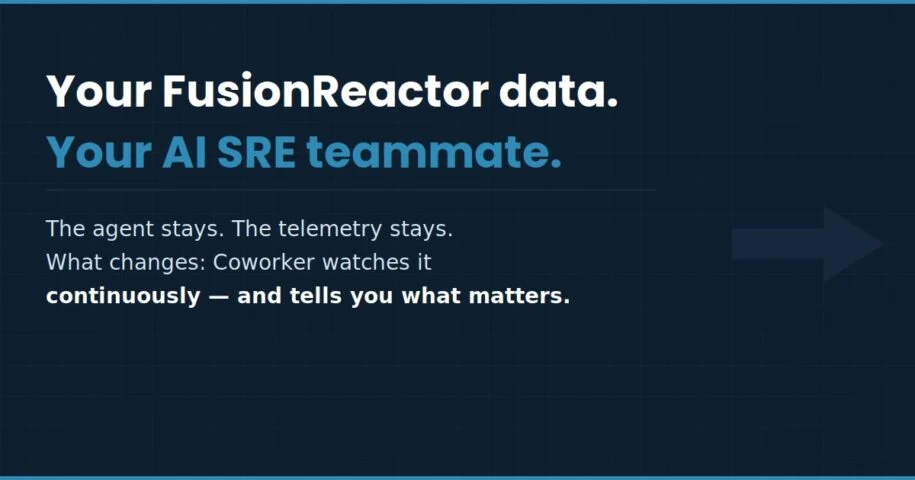
If you have been running FusionReactor for a while, you already know what it is good at. Deep JVM diagnostics. Transaction-level tracing. Thread and memory analysis. Real-time visibility into your Java and ColdFusion applications that would be hard to get any other way.
That hasn’t changed. The FusionReactor agent is still the best way to get detailed application-level insight into JVM-based systems, and it remains part of the Intergral product family alongside OpsPilot.
What has changed is the platform around it. The FusionReactor to OpsPilot upgrade is what FusionReactor has grown into — a full observability and AI SRE platform built for the operational demands of 2026, with the FusionReactor agent as one of its telemetry inputs. If you are still running FusionReactor in standalone mode, this post explains what moving to OpsPilot would give you — and why the migration is less of a migration than an upgrade.
What Stays the Same
Your FusionReactor agent stays. You do not re-instrument your applications. You do not replace the agent. You do not lose the deep JVM telemetry you have been relying on.
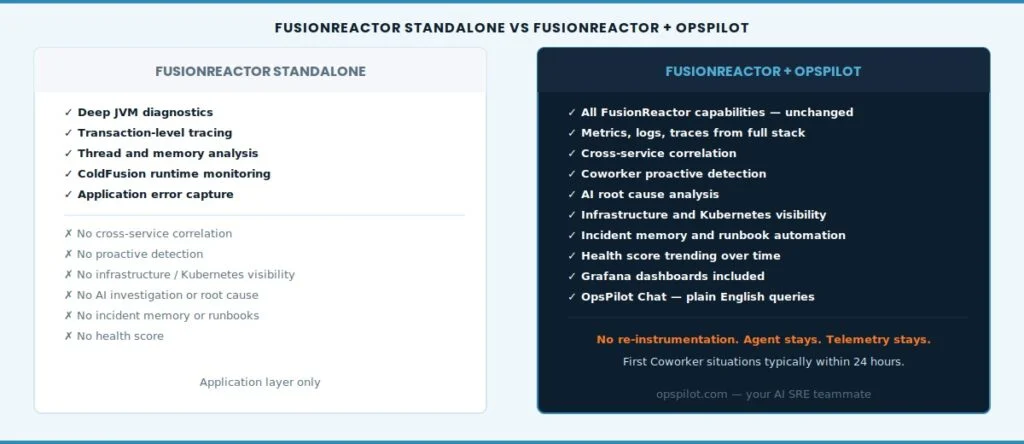
When FusionReactor is connected to OpsPilot, it moves from standalone mode to telemetry agent mode: the agent continues collecting the same detailed application and JVM data it always has — request tracing, method-level profiling, JVM metrics, error capture — and streams it into OpsPilot where it is joined by metrics, logs, and traces from the rest of your stack.
The data you trust from FusionReactor is the same data. It just goes further.
What You Get from the FusionReactor to OpsPilot Upgrade
A complete observability stack, not just APM. FusionReactor in standalone mode gives you deep visibility into your application layer. OpsPilot adds metrics from Prometheus, logs from Loki, and distributed traces from Tempo — so the picture extends beyond your Java application to your databases, your infrastructure, your dependencies, and your Kubernetes environment if you are running one. Cross-service correlation becomes possible because all signals are in the same place.
Coworker — your AI SRE. This is the biggest difference. Where FusionReactor surfaces what is happening, Coworker tells you what matters, why it is happening, and what to do about it. Coworker watches your production telemetry continuously — including the FusionReactor data you are already producing — and surfaces situations proactively: before thresholds are crossed, before users are affected, before your on-call engineer is paged. Each situation comes with the affected service, correlated signals across the full stack, a recommended action, and an estimated effort. No dashboard required.
Proactive detection, not just reactive monitoring. FusionReactor is excellent at telling you what is happening in your application right now. Coworker tells you what is trending toward a problem — patterns building toward connection pool exhaustion, memory pressure accumulating toward an OOM event, latency degradation developing hours before it becomes user-visible. The difference in on-call experience is significant: situations surfaced before the alert fires, during business hours, with context already assembled. For a detailed look at what that shift feels like operationally, see Proactive SRE: What the Shift from Reactive Actually Looks Like.
Health score and operational visibility. OpsPilot gives your production system a composite health score — a 0-100 metric that reflects the reliability of your services over time, trends in the right or wrong direction, and makes the reliability investment visible to engineering leadership without requiring a custom reporting layer.
Incident memory that improves over time. Coworker remembers every situation it surfaces and every resolution it observes. The next time a pattern recurs — a connection pool issue that has happened before, a memory leak pattern Coworker has seen — it surfaces it with historical context: what caused it, what resolved it, how long it took. Over time, recurring patterns become candidates for autonomous remediation: Coworker executes the approved runbook without paging anyone. For a full explanation of how this memory builds, see AI SRE Incident Memory.
Grafana dashboards alongside AI intelligence. OpsPilot is built on the Grafana stack — the same visualization technology you may already be using, now with Coworker’s intelligence layer above it. Your existing Grafana dashboards continue working. The difference is that Coworker is watching the same data continuously, surfacing what the dashboards don’t tell you.
What the FusionReactor OpsPilot Upgrade Actually Looks Like
Moving from FusionReactor standalone to OpsPilot is not a rip-and-replace. It is an addition.
The FusionReactor agent on your servers connects to OpsPilot rather than running in standalone mode. Your existing agent configuration stays largely intact — you are redirecting the telemetry, not changing how it is collected. Most teams connect their first data source and receive their first Coworker analysis within 24 hours. If you are running modern Java applications with existing OpenTelemetry instrumentation alongside FusionReactor, the setup is even faster.
The standalone FusionReactor UI is replaced by OpsPilot’s interface — the new, unified UI with side navigation, mobile support, and the Coworker page at the centre of the operational workflow. The Servers view in OpsPilot will be familiar: real-time and historic data, crash protection analysis, and JVM metrics in a cleaner layout.
What you gain immediately: Coworker’s first situations, the health score for your services, and the ability to ask your stack questions in plain English through OpsPilot Chat.
What builds over time: baselines for your specific traffic patterns, incident memory from observed situations and resolutions, and the runbook automation that emerges from that memory — including self-healing runbooks that execute automatically for approved recurring patterns. See Self-Healing Runbooks: What Autonomous Remediation Actually Looks Like for the full mechanics. For guidance on how to configure Coworker for your team’s current maturity — Reactive, Active, or Autonomous — see Coworker Modes: How to Choose the Right One for Your Team.
The Licensing
FusionReactor seats cover the agent running on your servers. The pricing is unchanged:
- Ultimate seat: $79/month per host (billed annually) or $95/month (billed monthly). Covers one unique host with up to 4 Java/ColdFusion instances or up to 4 Docker containers.
- On-demand: $0.13/hour per instance for usage beyond reserved seats.
OpsPilot plans — Starter, Pro, and Advanced — add the AI SRE and observability platform layer above the FusionReactor agent. If you are already running FusionReactor Ultimate, you are already partway there: the agent is collecting the data that OpsPilot needs. Adding OpsPilot adds Coworker, the full observability stack, and the AI intelligence layer on top of the telemetry you are already producing.
See the OpsPilot pricing page for plan comparison — no form, no sales call: opspilot.com/pricing/
Is This the Right Time?
If any of these descriptions fit your team right now, the answer is probably yes:
You are investigating incidents manually. Your FusionReactor data is good, but turning it into root cause still takes 30-60 minutes of dashboard querying and log searching. Coworker pre-assembles the investigation context for every situation it surfaces.
Your on-call rotation is painful. Engineers are being paged for incidents that repeat, for patterns that should have been caught earlier, and for problems that could have been resolved before they became incidents. Coworker catches many of these before the page fires. For the full picture on why the current on-call model is broken and what AI SRE changes, see AI SRE Platform and Incident Management.
You want to see the full picture, not just the application. FusionReactor is excellent at the Java application layer. If you need visibility into your databases, your Kubernetes infrastructure, your dependent services, and your cloud environment alongside your JVM data, OpsPilot brings all of that into one place.
You want to show leadership that reliability is improving. The OpsPilot health score is a leadership-visible metric that trends over time, making the reliability investment defensible without requiring a custom reporting project.
The 14-day free trial requires no credit card and no migration commitment. Connect your FusionReactor agent to OpsPilot, see what Coworker surfaces in your specific environment, and evaluate from there. First situations typically appear within 24 hours.
Frequently Asked Questions
No. The FusionReactor agent stays in place and continues doing exactly what it does today — collecting deep JVM and ColdFusion application telemetry. When connected to OpsPilot, the agent moves from standalone mode to telemetry agent mode: the same data it has always collected is streamed into OpsPilot, where Coworker adds the AI SRE intelligence layer above it. No re-instrumentation. No migration. Most teams connect their first data source and receive their first Coworker analysis within 24 hours.
FusionReactor gives you deep visibility into your Java and ColdFusion application layer — transaction tracing, JVM diagnostics, memory analysis, and error capture. OpsPilot adds the intelligence layer above that data: Coworker watches your telemetry continuously and surfaces situations proactively before alert thresholds are crossed, with pre-assembled root cause analysis and recommended actions. It also extends visibility beyond the application layer to your databases, infrastructure, Kubernetes environment, and dependent services — correlating signals across all of them in one place.
The standalone FusionReactor UI is replaced by OpsPilot's unified interface, which includes a Servers view with the same real-time and historic JVM data, crash protection analysis, and application metrics you are used to — in a cleaner, modernised layout with side navigation and mobile support. The Coworker page becomes the centre of your operational workflow, surfacing situations proactively in Slack and in-product. You also gain Grafana dashboards for the full observability stack and OpsPilot Chat for plain English queries against your telemetry.
OpsPilot receives the same detailed ColdFusion runtime telemetry that FusionReactor has always collected — request traces, JVM metrics, memory pressure, thread activity, and error capture. Coworker adds proactive detection on top of that data: identifying memory pressure trends before OOM events occur, correlating CF application errors with database and infrastructure signals, and surfacing situations during business hours rather than after on-call pages. The result is a shift from reactive monitoring — seeing what happened — to proactive operations: knowing what is trending toward a problem before it becomes one.
FusionReactor seat pricing is unchanged. Ultimate seats remain $79/month per host (billed annually) or $95/month (billed monthly), covering one unique host with up to 4 Java or ColdFusion instances or Docker containers. OpsPilot plans — Starter, Pro, and Advanced — are priced separately and add the AI SRE platform layer above your existing FusionReactor agent. See the OpsPilot pricing page for plan comparison with no form and no sales call.

Book a demo to see what OpsPilot adds to your existing FusionReactor setup →
OpsPilot is the AI SRE teammate built by Intergral — the team behind FusionReactor. It adds AI SRE intelligence and a full observability platform to the deep JVM telemetry FusionReactor has always provided. OpsPilot, formerly FusionReactor Cloud, is Intergral’s AI-powered observability and AI SRE platform.